If you’re buying, building, or remodeling in Richardson, Texas, knowing the local zoning rules can save you time, money, and headaches. Residential zoning governs everything from lot size and setbacks to what types of homes are allowed, from single-family homes to townhomes and duplexes.
What Zoning Means for You
Zoning in Richardson tells you:
- What uses are allowed on a parcel (single-family home, duplex, townhome, etc.)
- What building standards apply (minimum lot size, setbacks, building height, maximum lot coverage)
- Whether secondary uses are permitted (home-based businesses, short-term rentals, accessory dwelling units)
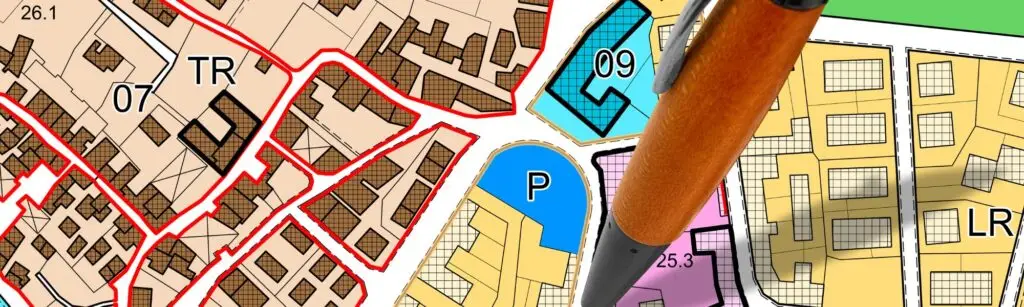
The city’s Comprehensive Zoning Ordinance (CZO) is the legal baseline, while the online Zoning Atlas map lets you quickly see your specific lot’s zone type.
Main Residential Zoning Districts
Richardson has several “R-point” districts and attached-home districts, each named roughly by the minimum lot size in square feet:
| District | Description | Common Use |
|---|---|---|
| R-2000-M | Very low-density single-family (2000 ft² min lot) | Larger-lot homes on city edges or older subdivisions |
| R-1800-M | Single-family residential (1800 ft² min lot) | Mature 1970s–1990s subdivisions across central Richardson |
| R-1500-M | Standard single-family residential (1500 ft² min lot) | Most common zone for mid-century neighborhoods |
| R-950-M, R-850-M/F | Smaller-lot single-family & patio-home zones | Infill lots, starter homes, patio-home communities |
| RA-1100-M | Attached residential (townhomes) | Row-style townhouses near retail or highway access |
| D-1400-M / D-2400-M | Duplex residential districts | Two-unit properties |
| A-series | Apartment districts | Rental-heavy areas |
Basic Numerical Standards
In most single-family R-point districts (R-1500-M, R-1800-M, etc.), typical standards include:
- Minimum lot area: Generally 1,500–2,000 square feet for single-family districts
- Front setbacks: Around 15–20 feet for new single-family houses
- Rear and side setbacks: Often 3–5 feet, with larger setbacks in larger-lot districts
- Building height: Most zones cap buildings at 2-1/2 stories or roughly 30–35 feet
- Lot coverage: Many areas limit paved area to around 50–60% of the lot
These numbers matter when you’re sizing additions, planning driveways or patios, or evaluating ADU feasibility.
Home-Based Businesses, Short-Term Rentals, and ADUs
Richardson tightly regulates non-residential activity in residential zones:
- Home-based businesses are allowed only if secondary to the dwelling and must follow specific limits on signage, traffic, parking, and employees
- Short-term rentals (Airbnb-style) are not broadly allowed in most single-family districts and often require special permits
- Accessory Dwelling Units (ADUs) are not automatically sanctioned in every zone; their legality depends on district-specific rules
How to Check Your Lot’s Zoning
Because zoning can change block-by-block, verify the official map and code for each address:
Richardson Zoning Atlas (interactive map)
Shows current zoning district for each parcel
https://www.cor.net/departments/development-services/maps/zoning-atlas
Comprehensive Zoning Ordinance (PDF and text)
Full ordinance with district chapters and dimensional tables
https://www.cor.net/departments/development-services/regulations-and-guidelines/comprehensive-zoning-ordinance
Richardson Code of Ordinances
Searchable online version
https://library.municode.com/tx/richardson/codes/code_of_ordinances
Residential “Quick Code” Reference
City summary of common residential issues
https://www.cor.net/departments/community-services/code-enforcement/residential-code-enforcement/residential-quick-code
Practical Tip
- Type your address into the Zoning Atlas to pull the exact district
- Then review the corresponding CZO article to see allowable uses and dimensional standards
When You May Need Variances
Even in a single-family zone, you might encounter dimensional conflicts that require:
- A Board of Adjustment variance under Article XXV of the CZO
- Approval under a Neighborhood Development Overlay (NDO) or Planned Development District
For investors and remodel-savvy buyers, overlay districts are worth checking early. Some NDOs tighten front-yard coverage or massing rules, while others offer more flexibility on density or building height along certain corridors.
Bottom line: Always check the zoning for your specific property before making purchase or remodeling decisions. The city’s online tools make it easy to verify what’s allowed on your lot.